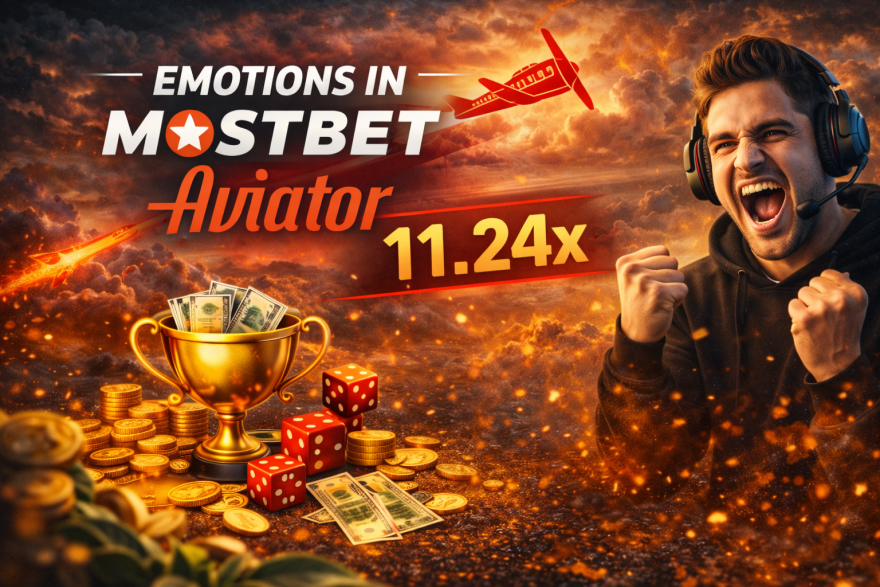
When the plane soars into the sky and the multiplier grows before your eyes, time seems to stand still. Mostbet Aviator Game is not just a game with odds and bets. It’s a real roller coaster ride for the nervous system, where the euphoria of victory can turn into the bitterness of defeat in a matter of seconds. What’s behind this exciting mechanic and why can’t millions of people around the world tear themselves away from their screens as they watch the red plane fly?
The Neurobiology of Excitement: How Aviator Manipulates the Brain
The secret of Aviator’s appeal lies deep in human biology. When a user places a bet and watches the multiplier grow, their brain releases a powerful surge of dopamine, a neurotransmitter responsible for feelings of pleasure and anticipation of reward. Research shows that it is the moment of anticipation, rather than the victory itself, that triggers the strongest dopamine response.
In Aviator, this mechanism works flawlessly. Each round lasts only a few seconds, but that’s enough time for the player to experience a whole range of emotions. When the multiplier reaches 1.5x, there is a temptation to take the winnings. At 2x, greed sets in — what if it reaches 5x? And if the plane flies away at 3.2x, there is disappointment that a higher coefficient was not achieved. This continuous chain of emotional surges keeps the brain in constant tension.
Psychologists note the “near-win” effect, when a player almost manages to collect their bet — the brain reacts to this almost as if it were a real win. That is why, after the plane flies away at 10x and you withdraw your money at 1.8x, you feel annoyance rather than relief. The feeling of a missed opportunity becomes a powerful incentive for the next bet.
Psychological Triggers: Why It’s Impossible to Stop
Game developers use a whole arsenal of psychological techniques to turn simple mechanics into an exciting experience. One of the most powerful tools is social proof — in real time, you can see other participants collecting winnings with multipliers of 5x, 10x or even 50x. This creates the illusion that a big win is not only possible, but literally one click away.
Mostbet uses this mechanic to its fullest, displaying other players’ statistics and creating an atmosphere of competition. When you see someone else just win with odds of 47x, your own caution starts to feel like cowardice. Fear of missing out (FOMO) makes you place riskier bets and keep your money in the game longer.
Another psychological hook is escalating involvement. Once a player has invested time and money, leaving the game is perceived as an admission of defeat. This is especially evident after a series of losses — there is an irresistible urge to “win back” what you lost, double your bet and prove to yourself that the failures were just a fluke.
Emotional Swings: From Euphoria to Despair
The uniqueness of Aviator lies in the speed with which emotional states change. Imagine: you bet 1,000 currency units, the plane takes off, the multiplier grows — 1.5x, 2x, 3x. Your adrenaline is skyrocketing, your hand reaches for the withdrawal button, but greed says: “Just a little more!” And then, at 3.2x, the plane flies away. Instead of winning 3,200 currency units, you are left with nothing. The emotional blow is so strong that the next bet is often made impulsively, under the influence of anger and the desire to immediately regain what has been lost.
Experts in the field of gaming psychology note several behavioural patterns that manifest themselves in just 10-15 minutes of play: impatience, impulsiveness, the desire to “prove” to the game that you are right, and anxiety. If a person cannot even wait for odds of 1.25 and withdraws money at the first signs of growth, this indicates a low level of confidence — both in the game and in themselves.
On the other hand, there are players who change the size of their bets every round, reacting to emotions rather than strategy. After losing, they double their bet in an attempt to compensate for their losses — this is no longer a calculation, but a purely emotional reaction. Aviator turns into a psychological test that shows how a person behaves in conditions of risk, uncertainty and limited time for decision-making.
Strategy Versus Emotions: Is It Possible to Play Wisely?
Despite all the emotional components, Aviator is a game with a mathematical basis. The Provably Fair algorithm guarantees the fairness of each round, and the average return rate is 97%. But the problem is that most losses occur not because of flaws in the game, but because of an inability to control emotions.
Mostbet login gives you access not only to the game, but also to tools that help you play more consciously. Automatic withdrawal at a set multiplier eliminates the need to make decisions at the height of emotion. Statistics show that users most often withdraw funds in the range of 1.35-1.50, as this is statistically the most stable zone where the probability of success is above average.
Experienced players advise using a double bet strategy:
- The first bet with automatic withdrawal at a low multiplier (e.g. 1.5x) for a guaranteed small profit.
- The second bet is manually controlled in an attempt to catch a high coefficient.
- A strict limit on the maximum amount of losses per session.
This tactic allows you to balance risk and stability without letting your emotions completely take control of the game.
Conclusions: Emotions as the Main Product
Aviator sells not so much the opportunity to win money as an emotional experience. Each round is a micro-drama with a beginning, climax and denouement, all within a few seconds. It is the intensity of the experience, rather than the size of the winnings, that keeps people coming back to the game again and again.
Understanding the psychological mechanisms behind this game does not necessarily spoil the fun. On the contrary, awareness allows you to experience emotions without losing control of the situation. Mostbet Pakistan can be exciting entertainment if you treat it as entertainment rather than a way to make money or solve life’s problems.